

Ricercare (Fantasia) No.16 by Francesco da Milano (PDF)
Ricercare (Fantasia) No.16 by Francesco da Milano (PDF)
Couldn't load pickup availability
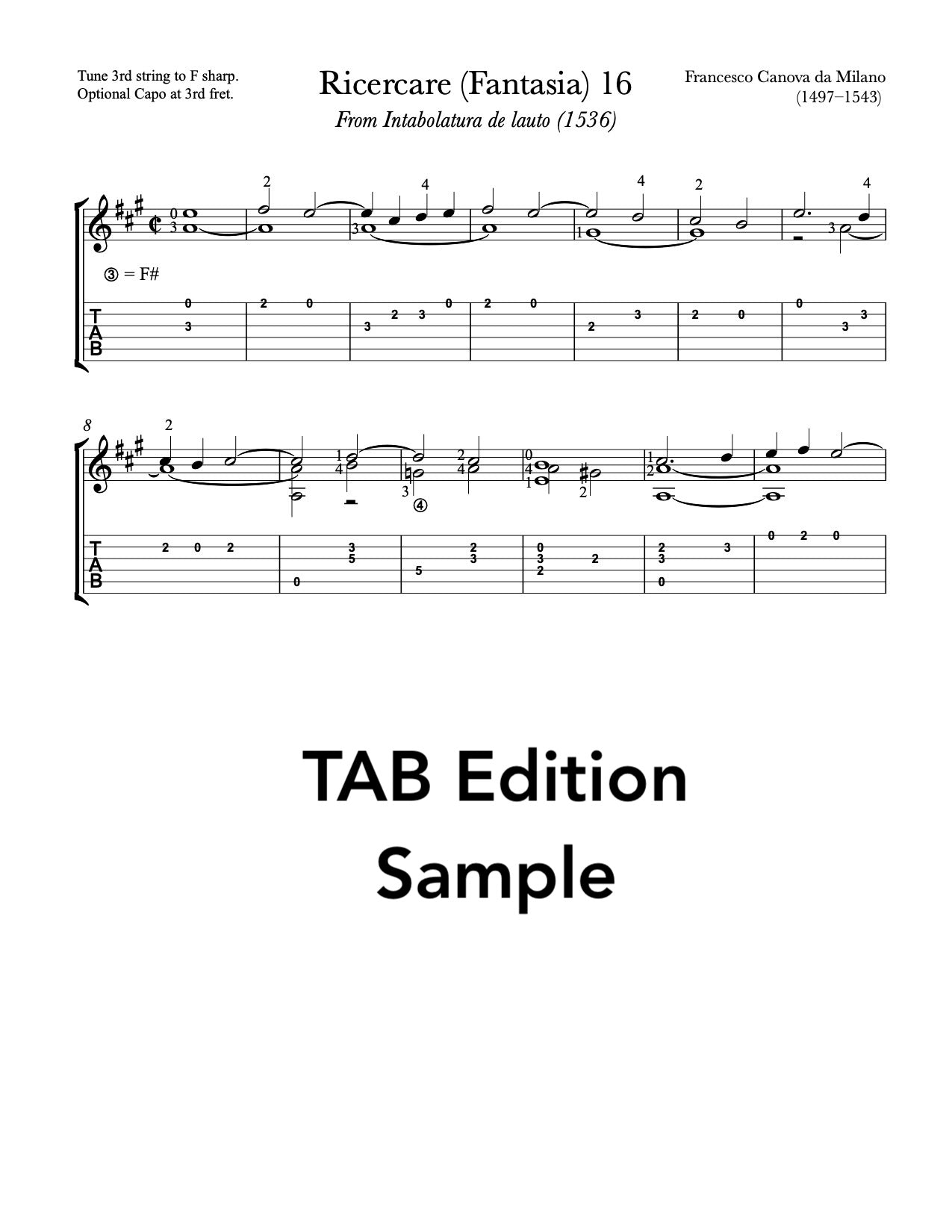
Ricercare (Fantasia) No.16 by Francesco Canova da Milano (1497–1543). PDF sheet music for classical guitar with video lesson and performance. Comes with both a notation edition with left hand fingering and a separate tab edition in the same PDF. Later-Intermediate level (Grade 7). This is a PDF Download.
Note: This score uses F# tuning on the 3rd string.
Francesco Canova da Milano (1497–1543) was an Italian lutenist and composer. He was praised throughout Europe as the foremost lute composer of his time. Francesco da Milano left a large quantity of lute music, including fantasias, ricercari and transcriptions of vocal compositions by leading composers of the time. More of his music is preserved than of any other lutenist of the period. A ricercare is an imitative work and, in some ways, a precursor to the Baroque fugue.
Numbering: Ness No. 16 (Arthur Ness, The Lute Music of Francesco Canova Da Milano, Harvard University Press, 1970). In my edition the same bar length as the original lute tablature has been used. The choice of rhythmic note duration comes from the Ness tablature. The Ness notation uses a more expansive bar structure but easy reference to the bar numbers of the original lute tablature has been deemed more important. Here's my YouTube Link if you need to view it there.
Video Performance and Lesson
Why do guitarists use capos and 3rd string F# tuning?
A bit more info on Milano: “Francesco Canova da Milano (1497–1543) was one of the greatest of all the Italian lute composers. His contemporaries called him “Il Divino”, as they did Michelangelo, and said he played “with such ravishing skill that little by little, making the strings languish under his fingers in his sublime way, he transported all those listening into a pleasurable melancholy”. His music appeared in more than forty publications throughout the century and in six countries; he was earliest of the many Italian musicians who were to become internationally renowned. He served at the court of four popes, starting with the first Medici pope Leo X (who excommunicated Luther and for whom Michelangelo painted the Sistine Chapel).” – Mark Lindley via Naxos (8.220401).
Share